What Is Cosmology? Unveiling the Study of Everything
Cosmology is the scientific study of the universe as a whole—its origin, structure, evolution, and ultimate destiny. When we ask where everything came from and where it is going, we are engaging with the very questions that define cosmology meaning. Unlike astronomy, which focuses on individual celestial objects, cosmology seeks to understand the universe as a single, coherent system.
In modern science, the cosmology we use today rests on a foundation of physics, mathematics, and deep-space observation. It combines data from telescopes, satellites, and cosmic background radiation detectors to piece together a story billions of years in the making. Visionaries like Albert Einstein redefined our understanding of space and time, while thinkers such as Carl Sagan brought Carl Sagan cosmology into the public imagination.
Cosmology is not just an academic pursuit; it is humanity’s most profound attempt to situate itself within the grand cosmic narrative.
The Big Bang: The Flat Universe’s Grand Opening
Roughly 13.8 billion years ago, the universe began in an unimaginably hot and dense state. It is a singular point that expanded rapidly in a process known as the Big Bang. This wasn’t an explosion in space, but rather an expansion of space itself. As it cooled, matter began to form, giving birth to hydrogen, helium, and the first light atoms that would later build stars and galaxies.
The Big Bang theory forms the backbone of inflationary cosmology. It proposes that a brief period of exponential expansion smoothed out irregularities in the early universe. This theory explains the universe’s large-scale uniformity and supports evidence that it is flat, with no measurable curvature.
Over billions of years, gravity drew matter together, forming galaxies, clusters, and the intricate structures we observe today. The Big Bang remains the most compelling scientific model for how “everything” began—a true cosmic opening act.
The Cosmic Recipe: Uncovering Dark Matter and Dark Energy in the Cosmology
If the universe were a recipe, ordinary matter—the stuff of stars and planets—would be just a tiny fraction.
Visible matter makes up only about 5% of the universe. The remainder is dark matter and dark energy.
Dark matter, about 27% of the cosmos, cannot be seen directly but holds galaxies together through gravity.
Without dark matter, stars at galaxies’ edges would drift into space.
Even more perplexing is dark energy, which accounts for nearly 68% of the universe. It acts as a kind of “anti-gravity,” pushing galaxies apart and accelerating the expansion of space. Cosmology Neil deGrasse Tyson often highlights this mystery in his discussions, calling dark energy one of the greatest puzzles in modern physics.
Together, these invisible components form the universe’s hidden backbone—an unseen scaffolding shaping everything from galaxy formation to the ultimate fate of cosmic expansion.
How Is the Universe Structured? A Look at the Cosmic Web
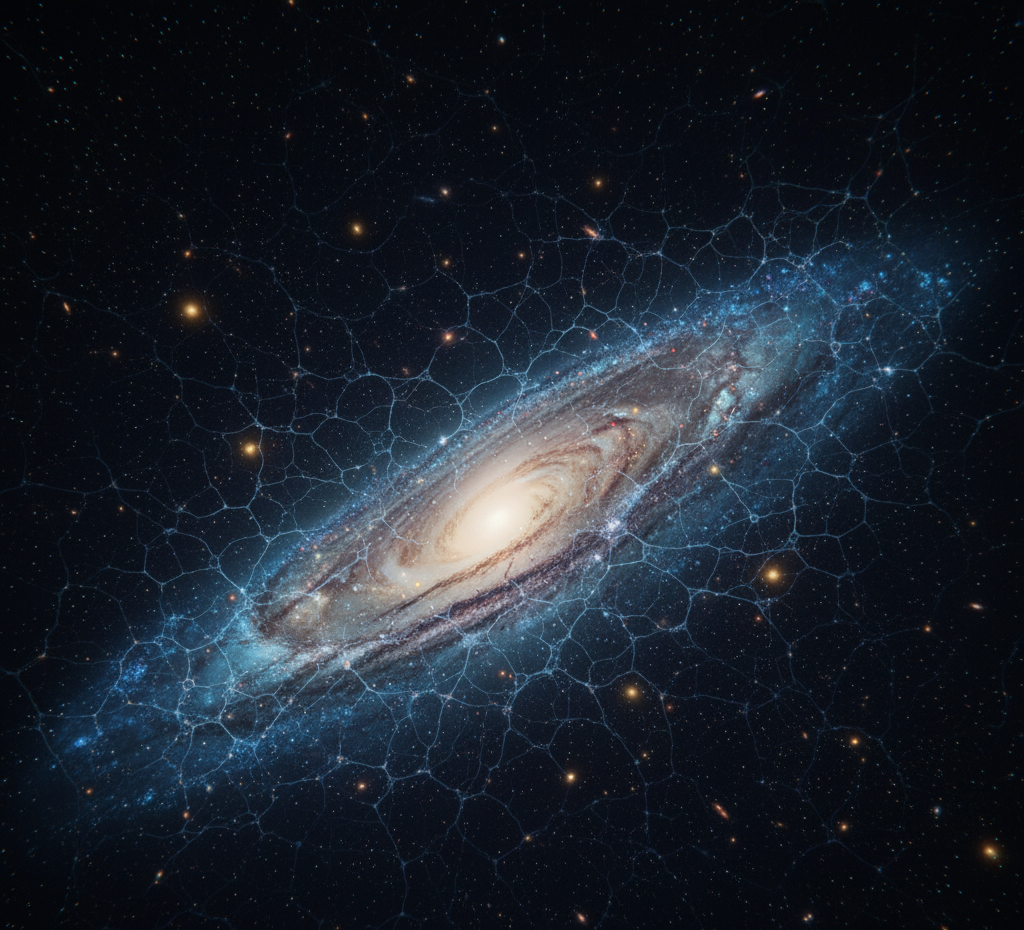
Zooming out from our galactic neighborhood, we find that galaxies are not randomly scattered but instead form vast interconnected structures called the Cosmic Web. These are immense filaments of galaxies and dark matter, stretching across billions of light-years, with enormous voids of empty space between them.
This structure is the result of gravity acting over eons, pulling matter into filaments while leaving behind great cosmic deserts. Computer simulations now allow scientists to visualize this architecture in breathtaking detail, showing how the universe’s geometry evolves over time.
Our Milky Way is just a tiny node in this web, orbiting within the Local Group of galaxies, which itself is part of the Virgo Supercluster. The sheer scale is staggering—each filament in the Cosmic Web can contain hundreds of thousands of galaxies, each galaxy containing hundreds of billions of stars. This pattern of structure is one of the greatest triumphs of observational cosmology, showing that from the smallest atom to the largest supercluster, the same physical laws prevail.
The Ultimate Question: What Is the Fate of Our Universe?
The universe is expanding—and faster every moment. But how will it end? Cosmologists have proposed several theories. One is the “Big Freeze,” where the expansion continues indefinitely until stars burn out and galaxies drift apart, leaving a dark, cold cosmos. Another is the “Big Crunch,” where gravity eventually reverses expansion and collapses everything back into a singularity.
Each of these scenarios depends on the exact nature of dark energy and how its influence changes over time. Observations of distant supernovae and the cosmic microwave background are refining these models, but the final answer remains elusive.
In this unexpected cosmology, uncertainty is part of the adventure. Our universe may be infinite in space but finite in time—or it may cycle endlessly through birth and rebirth. The beauty of cosmology lies not just in what it reveals, but in the vast horizon of questions it leaves open.
From the first flicker of creation to the last whisper of entropy, cosmology is the story of everything—and of our own curiosity woven into the fabric of the cosmos.
Conclusion: Our Place in the Cosmic Story
Black hole cosmology offers a fascinating lens for understanding the universe and our place within it. It shows that our atoms once belonged to stars that became black holes, whose gravity shapes galaxies and the cosmos. From the event horizons of black holes to the vast Cosmic Web, each discovery deepens our understanding of the universe’s intricate architecture.
Even with these insights, black hole cosmology teaches humility. Much of the universe remains hidden behind horizons we cannot cross. Dark matter, dark energy, and the interiors of black holes challenge our understanding, leaving mysteries that whisper through gravitational waves and radiation.
Following the spirit of Carl Sagan and Neil deGrasse Tyson, black hole cosmology inspires awe and curiosity. It demonstrates that science is not merely a collection of facts but a living story. Whether the universe ends in a Big Freeze, Big Rip, or cycles through black hole singularities, the journey of discovery persists, fueled by our desire to understand where we fit in the cosmic narrative.
Through black hole cosmology, we see ourselves reflected in the universe: small, luminous, and profoundly interconnected with all that ever existed or will exist.
FAQ
Dark matter is an invisible form of matter that doesn’t emit light but exerts gravity, holding galaxies together. Dark energy is a mysterious force driving the accelerated expansion of the universe. Although they make up about 95% of the cosmos, their true nature remains one of science’s biggest puzzles.
The Cosmic Web refers to the large-scale structure of the universe—an immense network of galaxy clusters, filaments, and voids stretching across billions of light-years. It’s how matter has organized itself under the influence of gravity since the early universe.