Introduction: A Changing Planet
Our Earth constantly evolves. Scientists tirelessly study its intricate systems. New discoveries emerge regularly. These insights are crucial for our future. They help us understand climate change. This article explores recent breakthroughs. We focus on 2024’s important findings.
Atmospheric Dynamics and Extreme Weather
Unraveling Atmospheric Rivers
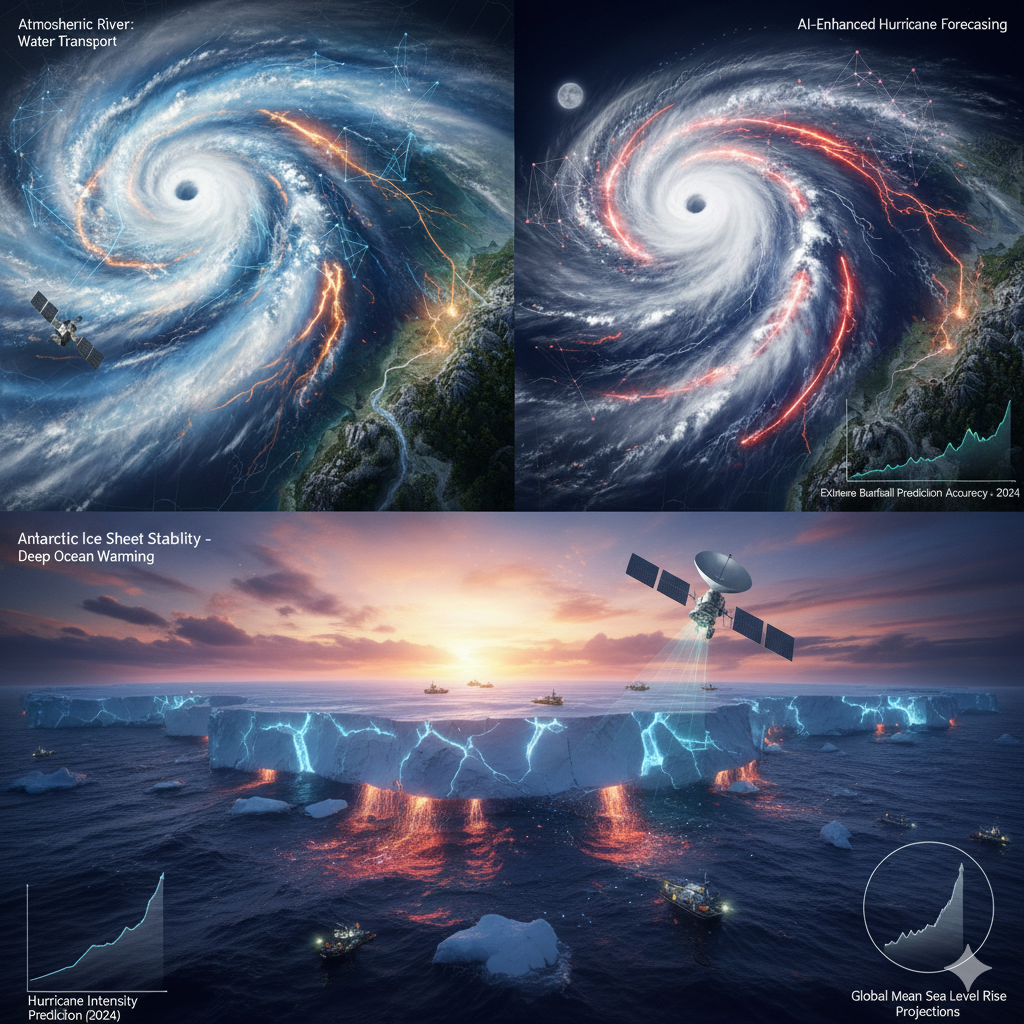
Atmospheric rivers are vital. They transport vast amounts of water. These narrow bands of moisture stretch across oceans. They impact global weather patterns significantly. New research refines our understanding. Scientists now better predict their behavior. This helps forecast extreme rainfall events. These events cause flooding and landslides.
Researchers use advanced modeling techniques. Satellite data provides crucial information. These tools reveal complex interactions. Atmospheric rivers connect to large-scale climate oscillations. Understanding these links is essential. It improves regional weather forecasts. It also aids water resource management.
Predicting Hurricane Intensity
Hurricane intensity prediction remains challenging. Scientists make significant strides. New models incorporate oceanic heat content. They also consider atmospheric stability. These factors drive hurricane intensification. Better predictions save lives. They allow for more effective evacuations.
Machine learning plays a growing role. AI analyzes vast datasets. It identifies patterns human eyes might miss. This technology enhances traditional models. It provides more accurate intensity forecasts. This work is critical for coastal communities. They face increasing hurricane threats.
Oceanography and Sea Level Rise
Deep Ocean Warming Trends
The deep ocean acts as a heat sink. It absorbs much of Earth’s excess heat. New data shows accelerated warming. This occurs even at great depths. This deep ocean warming has consequences. It affects marine ecosystems. It also contributes to thermal expansion. Thermal expansion causes sea level rise.
Scientists deploy autonomous floats. These instruments measure temperature and salinity. They provide long-term observations. These observations are vital for climate models. They help refine sea level rise projections. The pace of deep ocean warming surprises many.
Antarctic Ice Sheet Stability
The Antarctic ice sheet is immense. Its stability directly impacts global sea levels. Recent studies reveal worrying trends. East Antarctica shows signs of instability. Previously, it seemed more stable than West Antarctica. Warm ocean currents erode its edges. This accelerates ice melt.
Researchers use radar and gravimetry. These tools measure ice thickness and mass loss. Satellite missions provide consistent data. They track changes over time. Understanding these dynamics is paramount. It informs our future sea level rise scenarios. This research highlights urgent concerns.
Terrestrial Ecosystems and Carbon Cycles
Permafrost Thaw Acceleration
Permafrost stores vast amounts of carbon. It covers large areas of the Arctic. Rising temperatures cause permafrost to thaw. This releases greenhouse gases. Methane and carbon dioxide enter the atmosphere. This creates a powerful feedback loop. It accelerates global warming.
New studies show faster thawing rates. They also reveal deeper thaw penetration. Scientists monitor gas emissions closely. They use ground sensors and atmospheric sampling. This research underscores the urgency. Reducing emissions is critical. It helps slow this dangerous process.
Forest Fire Regimes Shift
Forest fires increase in frequency. They also grow in intensity. Climate change drives these shifts. Hotter, drier conditions fuel larger fires. These fires release massive carbon amounts. They also destroy vital ecosystems. This impacts biodiversity significantly.
Researchers study fire behavior. They use remote sensing and ecological modeling. These tools identify vulnerable areas. They help develop better fire management strategies. Understanding these new fire regimes is crucial. It informs conservation efforts. It protects human communities.
Paleoclimate and Climate Modeling
Reconstructing Past Climates
Paleoclimate studies look to the past. They use proxies like ice cores and tree rings. These records reveal Earth’s climate history. They show natural variability. They also highlight human impact. Understanding past warm periods is vital. It informs future climate projections.
New techniques improve resolution. Scientists now get finer details. They reconstruct ancient temperatures. They also track past greenhouse gas levels. This historical context is invaluable. It helps validate current climate models. It strengthens our understanding of climate sensitivity.
Next-Generation Climate Models
Climate models constantly improve. They become more sophisticated. Scientists incorporate new processes. They include ice sheet dynamics more accurately. They also better represent cloud physics. These advances enhance prediction accuracy. They offer clearer future scenarios.
Supercomputers power these models. They process enormous datasets. These models run complex simulations. They project climate change impacts. These projections guide policy decisions. They help society adapt to change. They are essential tools for planning.
Section 5: Climate Change Impacts and Adaptation
Impact on Water Resources
Climate change severely impacts water. It alters precipitation patterns. Some regions face increased droughts. Others experience more intense floods. This strains water supplies globally. It affects agriculture and human populations. Water security becomes a major concern.
Scientists assess regional impacts. They use hydrological models. These models predict future water availability. They help develop adaptation strategies. Efficient water management is essential. Investment in infrastructure is also key.
Ecosystem Response and Resilience
Ecosystems face immense pressure. They respond to rapid climate shifts. Some species migrate. Others struggle to adapt. Biodiversity loss is a serious threat. Understanding ecosystem resilience is vital. It informs conservation efforts.
Researchers study species adaptation. They track population changes. They also analyze genetic responses. Protecting critical habitats helps. Restoring degraded ecosystems is also important. These actions enhance natural resilience.
Technological Advances in Monitoring
Satellite Earth Observation
Satellites revolutionize Earth science. They provide continuous global data, and track ice melt, sea level, and deforestation. They also monitor atmospheric gases. New satellite missions launch regularly. These missions offer unprecedented detail.
High-resolution imagery is now standard. It enables precise measurements. This technology supports climate research. It also aids disaster response. Satellite data is a cornerstone. It underpins much of our understanding.
AI and Machine Learning in Climate Science
AI is transforming climate science. Machine learning algorithms process vast data. They identify subtle climate patterns, and improve prediction accuracy. They also accelerate complex simulations. AI tools enhance human analysis.
AI assists in weather forecasting. It helps model extreme events. It also optimizes renewable energy systems. This technology offers powerful solutions. It accelerates our understanding. It helps us tackle climate challenges.
Geodynamics and Earth’s Interior
Understanding Plate Tectonics
Plate tectonics shapes our planet. It causes earthquakes and volcanoes. Scientists refine our understanding. They study mantle convection. This process drives plate movement. New imaging techniques reveal subsurface structures.
Seismic tomography provides insights. It maps the Earth’s interior. This helps predict geological hazards. It also explains crustal deformation. This ongoing research is fundamental. It explains Earth’s dynamic nature.
Geothermal Energy Potential
Geothermal energy is a clean source. It taps into Earth’s internal heat. New technologies enhance extraction. Scientists identify new reservoirs. Advanced drilling techniques improve access. This expands renewable energy options.
Understanding subsurface geology is key. It optimizes geothermal power plants. This energy source offers stability. It reduces reliance on fossil fuels. Geothermal energy has significant potential. It aids climate change mitigation.
Polar Regions and Cryosphere
Arctic Amplification Effects
The Arctic warms faster than average. This phenomenon is Arctic amplification. It causes rapid sea ice loss. It also accelerates permafrost thaw. This has global consequences. It affects ocean currents and weather patterns.
Researchers use a range of tools. They deploy Arctic buoys. They also use atmospheric sensors. These provide crucial data. Understanding amplification is urgent. It helps predict future climate impacts.
Glacier Retreat Monitoring
Glaciers are vital freshwater sources. They also contribute to sea level rise. Most glaciers are retreating globally. This retreat accelerates in many regions. Scientists monitor these changes closely.
Satellite imagery tracks glacier mass loss. Ground measurements provide validation. These observations inform water management. They highlight the scale of warming. Glacier retreat is a stark climate indicator.
Carbon Capture and Storage
Advancements in CCS Technology
Carbon capture and storage (CCS) is crucial. It removes CO2 from emissions. It then stores it underground. New technologies improve efficiency. They reduce costs of carbon capture. This offers a path to lower emissions.
Researchers develop new materials. These materials absorb CO2 effectively. Geologists identify suitable storage sites. This technology is gaining traction. It is an important part of climate solutions.
Natural Carbon Sinks Enhancement
Natural sinks absorb vast CO2 amounts. Forests and oceans are key examples. Scientists explore enhancing these sinks. Reforestation efforts are vital. Protecting marine ecosystems also helps.
Blue carbon initiatives focus on coastal habitats. Mangroves and salt marshes sequester carbon. Restoring these areas has dual benefits. It stores carbon and protects coasts. This natural approach is powerful.
Citizen Science and Data Collection
Public Involvement in Research
Citizen science empowers individuals. It involves the public in data collection. People observe local weather patterns. They monitor plant and animal life. This broadens research scope. It engages communities directly.
Apps and online platforms facilitate this. Volunteers contribute valuable data. This helps track climate indicators. It also raises environmental awareness. Citizen science is a growing field. It benefits science and society.
Educational Outreach Initiatives
Education is crucial for climate action. Scientists engage the public directly. They share findings clearly. They explain climate impacts. This fosters informed decision-making. It builds support for solutions.
Workshops and public lectures are common. Online resources provide information. Engaging the next generation is vital. Education strengthens climate literacy. It promotes responsible stewardship.
Conclusion: A Collaborative Future
Earth and climate science progresses rapidly. New discoveries shape our understanding. They highlight urgent challenges. They also offer paths to solutions. Collaboration is key. Scientists, policymakers, and the public must work together. Our planet’s future depends on it. Continued research provides the foundation.
FAQ
The most significant new finding concerns the Antarctic ice sheet. Recent studies indicate worrying signs of instability and accelerated melting even in parts of East Antarctica, which was previously considered more stable than West Antarctica. This deepens concerns about future global sea level rise projections, as warm ocean currents erode the ice sheet’s edges.
AI, particularly machine learning, enhances climate science in several critical ways:
It significantly improves hurricane intensity and rainfall prediction accuracy by analyzing vast datasets and identifying complex patterns that traditional models might miss.
It helps accelerate complex climate simulations and process the enormous amount of data generated by next-generation climate models and satellite Earth observation systems.
It assists in identifying subtle climate patterns and optimizing renewable energy systems.
The acceleration of permafrost thaw is a major concern because permafrost holds vast quantities of stored organic carbon. When it thaws, this organic matter decomposes and releases significant amounts of powerful greenhouse gases, such as methane and carbon dioxide, into the atmosphere. This release creates a dangerous positive feedback loop that further accelerates global warming, compounding the overall climate crisis.