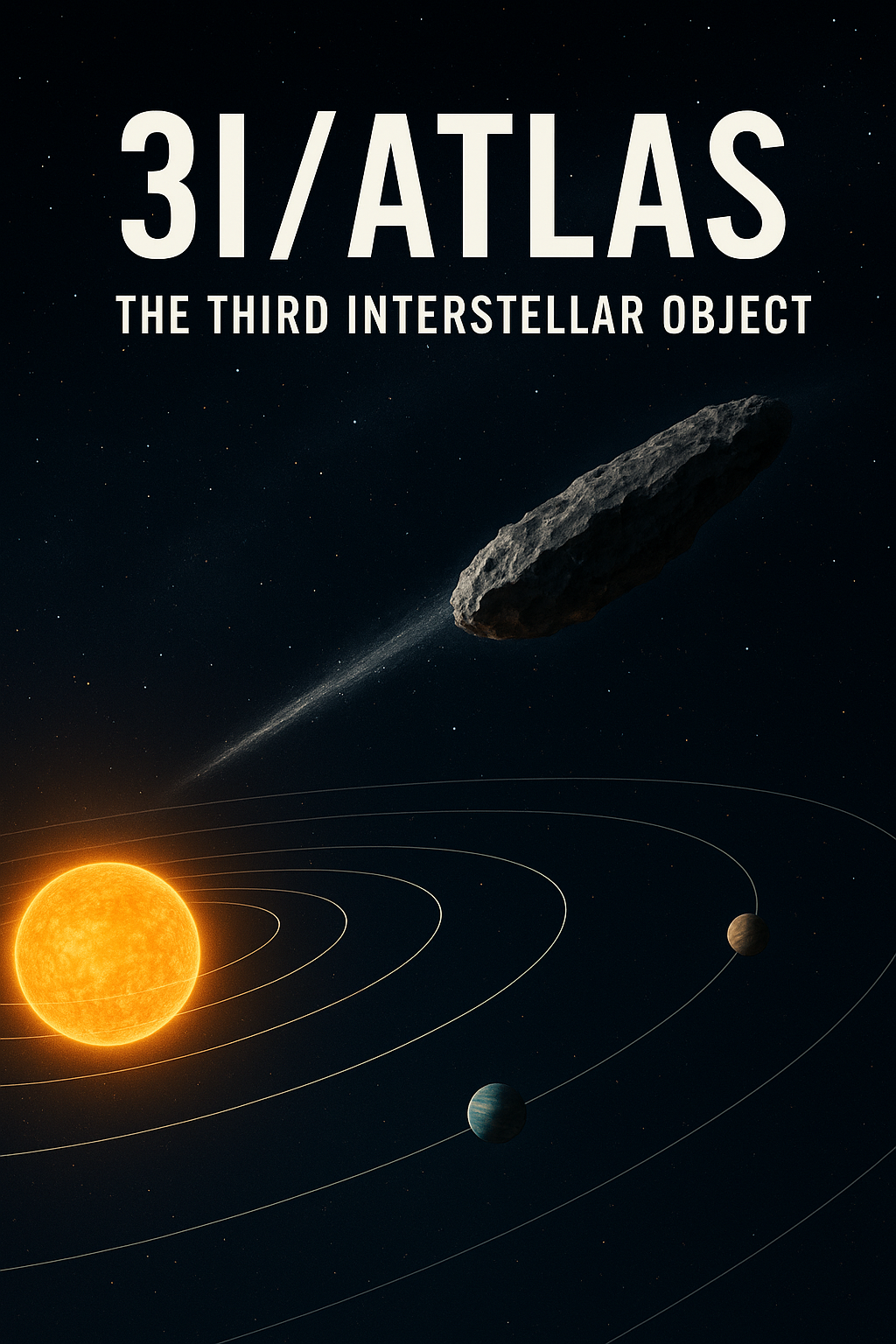
What Is 3I/ATLAS and How Was It Discovered?
3I/ATLAS is the third confirmed interstellar object ever detected entering our Solar System, following the famous 1I/ʻOumuamua in 2017 and 2I/Borisov in 2019. The designation “3I” identifies it as the third such discovery, while “ATLAS” refers to the Asteroid Terrestrial-impact Last Alert System, a network of survey telescopes in Hawaii designed to spot potentially hazardous asteroids approaching Earth.
In early 2025, the ATLAS system recorded an unusual object moving at extraordinary speed — fast enough that it could not be gravitationally bound to the Sun. Astronomers quickly recognized its hyperbolic trajectory, the telltale signature of an interstellar traveler. Subsequent follow-up observations from observatories around the world confirmed its origin beyond our solar neighborhood.
At discovery, 3I/ATLAS appeared as a faint, rapidly shifting point of light. Early measurements suggested it was only a few hundred meters across, though its exact size and composition remain uncertain. The combination of speed, brightness, and orbital geometry made it clear this was no ordinary comet or asteroid.
The arrival of 3I/ATLAS opens a new chapter in the study of interstellar visitors — each one a fragment of another solar system, offering a fleeting glimpse into the chemistry and physics of distant stars.
The Meaning Behind the Name
Astronomical names often seem cryptic at first glance, but they follow a precise logic. The name 3I/ATLAS reveals both the object’s nature and its discoverer. The “3I” prefix stands for third interstellar object, distinguishing it from any comet or asteroid born within our Solar System. It follows the naming tradition established by the earlier interstellar visitors — 1I/ʻOumuamua and 2I/Borisov — where the “I” denotes interstellar.
The second part, “ATLAS,” honors the Asteroid Terrestrial-impact Last Alert System, the automated sky-survey project responsible for its discovery. ATLAS operates a network of wide-field telescopes in Hawaii and Chile, continuously scanning the heavens for moving objects that might pose a threat to Earth. In the process, it also detects rare, fast-moving bodies like 3I/ATLAS that are merely passing through.
This naming convention isn’t just a formality — it helps scientists categorize and track unusual objects across global databases. Every component of the designation carries historical and scientific meaning, linking each discovery to a growing lineage of interstellar visitors. In this sense, 3I/ATLAS is not just a name; it’s a data label that connects Earth’s astronomers to a much larger cosmic story.
Interstellar Objects: A Brief History Before 3I/ATLAS
Before 3I/ATLAS streaked across astronomers’ detectors, only two confirmed interstellar objects had ever been identified — each rewriting our understanding of what drifts between the stars.
The first, 1I/ʻOumuamua, was discovered in 2017 by the Pan-STARRS observatory in Hawaii. Its name, meaning “a messenger from afar arriving first” in Hawaiian, proved fitting. ʻOumuamua baffled scientists with its odd, elongated shape and its unexpected acceleration as it left the Solar System. Some hypothesized it was a fragment of an exoplanet; others speculated about exotic possibilities like a thin, tumbling sheet of material shaped by radiation pressure.
Two years later came 2I/Borisov, found by amateur astronomer Gennadiy Borisov in Crimea. Unlike ʻOumuamua, Borisov was clearly cometary — trailing gas and dust, and behaving like the icy bodies that orbit our Sun. Its composition closely matched comets in our own Solar System, hinting that planetary systems across the galaxy may form from similar ingredients.
Together, ʻOumuamua and Borisov revealed that interstellar visitors aren’t mythical rarities but natural wanderers — fragments of distant worlds occasionally crossing paths with ours. With 3I/ATLAS, astronomers now have a third data point, offering the chance to test whether these cosmic travelers share a common story or come from entirely different origins.
Its Journey Through Our Solar System
3I/ATLAS is currently tracing a hyperbolic path through the Solar System — a one-way trajectory that ensures it will never return. Unlike comets bound by the Sun’s gravity, interstellar objects like this one arrive from deep space, swing briefly around our star, and vanish back into the interstellar void.
Based on current orbital calculations, 3I/ATLAS entered the Solar System from the direction of the constellation Hercules, moving at tens of kilometers per second — far faster than typical asteroids or comets. Its high velocity and eccentricity confirmed that it is not gravitationally tethered to the Sun. As it approaches perihelion, its closest point to the Sun, it will become faintly visible through medium to large telescopes before receding into darkness.
Astronomers worldwide are racing to observe it while they can. The object’s path takes it between the orbits of Mars and Earth, making it briefly accessible for spectroscopy and imaging. Every observation counts: once it passes beyond Jupiter’s orbit, 3I/ATLAS will fade rapidly and disappear into interstellar space, carrying its secrets back into the galactic night.
Each interstellar traveler like this leaves a fleeting trace — a reminder that our Solar System is not an isolated bubble, but a stopover along the galaxy’s endless routes of wandering debris.
Composition and Physical Characteristics
Because 3I/ATLAS is already moving at enormous speed and will soon fade from view, scientists have only a narrow window to study its makeup. Early observations suggest it is a relatively small body — likely a few hundred meters across — but its brightness and reflectivity make precise size estimates tricky. Whether it’s an icy comet or a rocky asteroid remains an open question.
Spectroscopic studies, which analyze the light reflected from the object, aim to uncover its composition. If 3I/ATLAS contains volatile materials such as water ice or carbon compounds, it may behave like a comet, developing a faint tail as it nears the Sun. However, if it remains inert, that would suggest a surface hardened by cosmic radiation — perhaps similar to ʻOumuamua’s dry, reddish crust.
Its unusual color and brightness variations hint at a tumbling rotation, meaning it doesn’t spin smoothly on a single axis. This chaotic motion could result from collisions or long exposure to stellar radiation during its interstellar voyage.
Each faint photon of light we collect tells part of its story. By comparing its spectral fingerprint to known asteroids and comets, astronomers hope to trace 3I/ATLAS back to the kind of star system it once called home.
How 3I/ATLAS Differs from ʻOumuamua and Borisov
Each interstellar visitor has carried its own mystery, and 3I/ATLAS is no exception. While all three objects share unbound orbits that prove their origins beyond the Solar System, their physical behaviors and appearances reveal striking differences.
ʻOumuamua, the first of its kind, was oddly shaped and displayed a subtle acceleration that couldn’t be explained by gravity alone. It showed no cometary tail, which led to speculation about exotic materials or even artificial origins. Two years later, 2I/Borisov behaved like a textbook comet, releasing gas and dust as it approached the Sun. Its composition resembled familiar Solar System comets, suggesting that planetary systems across the galaxy share similar chemistry.
3I/ATLAS seems to occupy a middle ground between the two. Early reports indicate it shows faint outgassing, but not as dramatically as Borisov. Its brightness fluctuates more like a rotating asteroid, and its surface appears darker than expected for a comet. This hybrid behavior challenges existing categories, hinting that interstellar objects may span a wide spectrum of types rather than fitting neatly into “asteroid” or “comet” boxes.
As observations continue, 3I/ATLAS could redefine how astronomers classify material arriving from other stars — a small traveler carrying big implications for planetary science.
What It Tells Us About Other Star Systems
Every interstellar object is a messenger from an unseen world. 3I/ATLAS, like its predecessors, carries within it the physical record of a solar system that once formed, evolved, and perhaps even birthed planets around another star. Studying its chemistry, motion, and structure helps astronomers reverse-engineer the conditions of its long-lost home.
If 3I/ATLAS contains frozen volatiles it would suggest that its parent system had an outer region similar to our Kuiper Belt, where icy bodies form beyond the frost line. Conversely, a rocky, inert composition would point to an origin closer to its star, perhaps ejected during the violent early days of planet formation.
The isotope ratios of elements within its gases, if measurable, could even hint at what kind of star it once orbited — young or old, massive or small, metal-rich or poor. In this sense, 3I/ATLAS functions as a cosmic sample return mission delivered by nature itself.
Though its visit is brief, it offers astronomers a rare chance to compare other planetary systems to our own, bridging light-years through chemistry and motion. Each observation tightens the thread connecting us to the wider galactic ecosystem from which we all emerged.
The Technology Behind the Discovery: Inside the ATLAS System
The detection of 3I/ATLAS highlights the power of modern astronomical technology. The Asteroid Terrestrial-impact Last Alert System (ATLAS) is a network of robotic telescopes located in Hawaii and Chile, designed primarily to identify potentially hazardous asteroids. Yet its wide-field cameras and rapid-scan capabilities make it equally adept at spotting fast-moving, faint objects like interstellar visitors.
Each ATLAS telescope can survey the entire visible sky every few nights, capturing repeated images that software then analyzes for moving points of light. When an object deviates from expected paths, automated alerts are sent to astronomers worldwide. This system allows researchers to respond quickly to fleeting phenomena, such as 3I/ATLAS, which may only be observable for weeks or months.
The discovery also relies on high-speed data processing and advanced algorithms capable of differentiating true celestial objects from cosmic rays, satellites, or instrumental noise. Once identified, additional observatories — including both professional and amateur telescopes — follow up to refine measurements of orbit, brightness, and composition.
ATLAS represents a new era in astronomy, where networks of automated instruments collaborate globally, enabling the discovery of rare and transient interstellar visitors. Without such technology, 3I/ATLAS might have passed unnoticed through our Solar System.
Could 3I/ATLAS Carry Clues About Life Beyond the Solar System?
Interstellar objects like 3I/ATLAS offer more than just insights into planetary formation; they may also carry subtle hints about the chemical precursors of life. Comets and asteroids are known to harbor organic molecules. If 3I/ATLAS contains similar materials, it could provide a snapshot of the organic chemistry occurring around distant stars.
While direct detection of life is extraordinarily unlikely, studying the presence of amino acids, simple sugars, or other prebiotic compounds could illuminate how widespread the ingredients for life are across the galaxy. Each interstellar visitor essentially functions as a natural probe, delivering material from other planetary systems without the need for space missions spanning light-years.
Moreover, comparing 3I/ATLAS to previous interstellar objects allows scientists to see whether organic-rich bodies are common or rare in the galaxy. Such knowledge informs broader questions: Is our Solar System chemically typical, or an outlier? Could panspermia — the transfer of life or its precursors between star systems — be a realistic process?
Why the Discovery of 3I/ATLAS Matters for the Future of Astronomy
The brief passage of 3I/ATLAS through our Solar System is more than a fleeting curiosity. It is a powerful reminder of the dynamic, interconnected galaxy we inhabit.
The discovery underscores the importance of automated, wide-field surveys like ATLAS, as well as global collaboration between professional and amateur astronomers. Observations of 3I/ATLAS will refine models of object trajectories, composition, and behavior, improving predictions for future interstellar visitors. This growing dataset helps scientists prepare for the next unexpected traveler, increasing the chances of capturing high-resolution images or even planning future interception missions.
Furthermore, 3I/ATLAS enriches our understanding of the chemical and physical diversity of the galaxy. By comparing it to 1I/ʻOumuamua and 2I/Borisov, researchers can begin to categorize interstellar objects, identifying patterns that reveal the typical properties of other planetary systems.
Ultimately, each new interstellar object reminds us that our Solar System is not isolated, but part of a larger, ever-changing cosmic network. 3I/ATLAS is a messenger from beyond, offering both knowledge and inspiration — a fleeting visitor that leaves a lasting mark on the future of astronomy.
Conclusion: 3I/ATLAS — A Cosmic Messenger in Cosmology’s Grand Play
The discovery of 3I/ATLAS stands as a vivid reminder that our Solar System is not a sealed box but a node in the wider galactic web. As the third confirmed interstellar object, it invites us to ask bigger questions: about how planetary systems form across the Milky Way, about the material exchange between stars, and about our place in the cosmic story. One recent study—titled “Extreme Negative Polarisation of New Interstellar Comet 3I/ATLAS” arXiv—adds to the growing dataset that helps anchor such questions in evidence.
In the context of cosmology, the study of the universe at its largest scales, 3I/ATLAS is a grain of dust offering insight into processes typically reserved for far‑away star systems and perhaps the remnants of early‑generation systems. And when we think of black hole physics, there’s a useful analogy: just as matter can escape or be flung out of the deep gravity wells of black holes, so too can planetesimals be ejected from their stellar nurseries and traverse the galactic sea until one of them visits us.
FAQ
3I/ATLAS is the third confirmed interstellar object detected in our Solar System. Unlike regular asteroids or comets, it originated outside our Solar System and follows a hyperbolic trajectory, meaning it is only passing through and will never orbit the Sun. It was discovered in early 2025 by the ATLAS (Asteroid Terrestrial-impact Last Alert System) telescopes in Hawaii.
While ʻOumuamua appeared as a rocky, cigar-shaped object with unusual acceleration, and 2I/Borisov behaved like a typical icy comet, 3I/ATLAS exhibits hybrid behavior. It shows faint outgassing like a comet but also surface characteristics more typical of asteroids. Its brightness fluctuates as it rotates, suggesting a tumbling motion rather than a smooth spin.
Studying 3I/ATLAS allows astronomers to learn about the material and processes in planetary systems beyond our own. Its composition, trajectory, and behavior provide insights into how planetesimals form, how matter is ejected from other systems, and even the prevalence of organic compounds that may play a role in the origin of life.
While 3I/ATLAS itself is not directly related to black holes, its study informs cosmology by offering clues about the distribution of matter across the galaxy and the evolution of planetary systems. Analogously, understanding how interstellar objects are ejected from their home systems can offer insights into extreme gravitational dynamics, similar in principle to the way matter interacts with black holes.